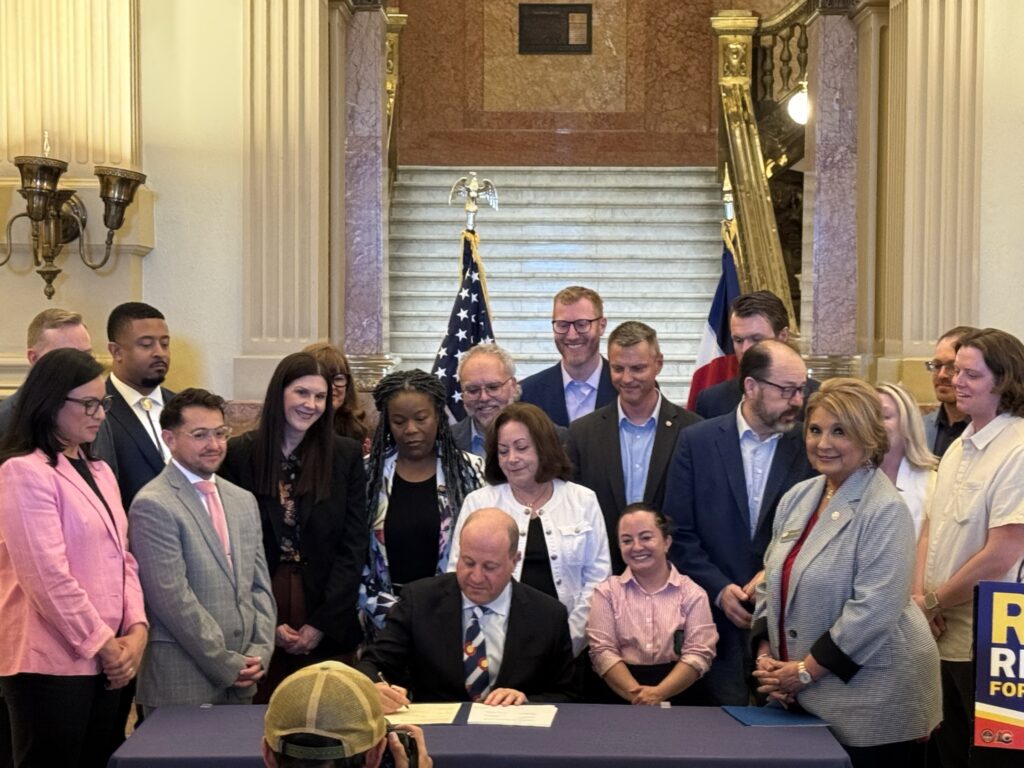

In 2023, the Colorado legislature created the Task Force on the Rights of Coloradans with Disabilities with a declaration that protection from discrimination and basic access to government services, housing, employment, and recreation are fundamental to the well-being of Coloradans with disabilities. The Task Force was charged with examining those issues across four subcommittees covering government accessibility, housing, the outdoors, and a rewrite of Colorado’s civil rights statutes for persons with disabilities.
Confluence was selected by the Department of Regulatory Agencies and its Civil Rights Division to facilitate and manage the work of the Task Force and all four subcommittees. The work required coordinating multiple bodies with distinct charges, integrating testimony from dozens of stakeholders with direct lived experience, and producing recommendations that could hold across a politically diverse set of interests. The Task Force published its final report in January 2025, containing 58 recommendations.
 Colorado educators had been reporting unsafe working conditions for years. The data available to state leaders did not reflect what was actually happening in classrooms. HB24-1320 created the Colorado Educator Safety Task Force (ESTF) and directed it to examine aggressive and violent behavior by students toward staff. The Office of School Safety contracted with Confluence to manage and facilitate the work.
The 17-member Task Force met monthly from September 2024 through June 2025, supported by four subcommittees that brought in dozens of additional participants with subject matter expertise, lived experience, and direct professional knowledge. To generate findings the existing data had missed, Confluence designed and administered a survey of more than 1,100 educators. More than 50 percent reported being physically injured by a student, a finding that contradicted all available prior data and reframed the conversation about what state action was actually required.
The Task Force published a Roadmap for Action along with role-specific roadmaps for educators, building leaders, district leaders, state agencies, and preparation programs. The findings and recommendations have been incorporated into ongoing work by the Colorado Department of Education and the Office of School Safety.
After Hurricanes Irma and Maria devastated Puerto Rico’s school system, the Governor and Secretary of Education faced a question that went beyond rebuilding facilities: how to redesign the system of career pathways for students in a way that would produce real economic opportunity, not just credentials. At their invitation, Abramson designed and led a multi-phase initiative to modernize career pathways as part of the broader school system redesign.
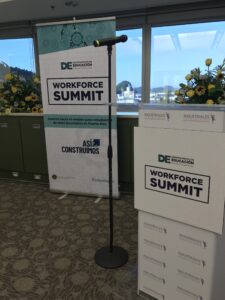 The initiative established first-of-their-kind partnerships between schools and employers. In the first year, more than 1,400 students were matched with employers for work-based learning opportunities, with more than 800 guaranteed a job at a living wage upon completion. The work was recognized by the Clinton Global Initiative with an Ideas Into Action award.

The Colorado Commission on Criminal and Juvenile Justice had guided state criminal justice policy for nearly twenty years. In 2023, a bill to reauthorize it was postponed indefinitely, sunsetting the body without a replacement. Governor Polis issued an executive order creating the Working Group on Transforming Criminal and Juvenile Justice (TCJJ) and directed it to recommend the structure, purpose, and composition of a new permanent entity.
Confluence was selected to facilitate the 17-member group, which included prosecutors, defense attorneys, law enforcement, reform advocates, and stakeholders with diverse professional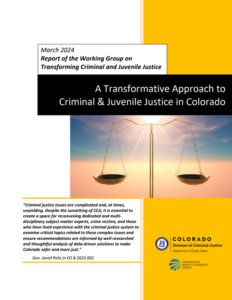 and lived experience perspectives. The process brought more than 50 outside voices into the deliberations before the group turned to its own recommendations. After extensive deliberation, the TCJJ reached consensus on the mission, vision, structure, and membership for two new permanent commissions to address adult and juvenile justice. The final report was published in March 2024.