“I’ve done one to two task forces a year for the last 18 years. Hands down, this is the best run one. State agencies should just be required to hire you all.”
Working group member · Colorado state government
Colorado AI Policy Working Group · SB26-189
RTD Accountability Committee · SB25-161
Participants are asked to vote before they understand the problem, and to negotiate before they trust each other. The order determines the outcome.
Facilitators convene the group and assume participants are ready to engage openly. They are not. What they need before the first session is a private conversation.
Groups move to solutions before they have agreed on what problem they are solving. The result is proposals that talk past each other.
Negotiations happen over abstract positions rather than actual text. Agreements that cannot be written down are not agreements.
Colorado AI Governance Framework · Senate vote · after three failed sessions
RTD governance recommendations codified in legislation after years of gridlock
Before the first group session, Confluence conducts individual pre-session conversations with every participant. These are not briefings. They are the beginning of the process. Each conversation surfaces what the participant cares about, what they need to engage without reservation, and what would make the process feel legitimate to them. The group session that follows is built on what those conversations reveal.
People do not say in a group what they say in private. The facilitator who skips this step is designing a process around the public positions rather than the real interests. That process will produce theater, not agreement.
Task force participant · civil rights engagement
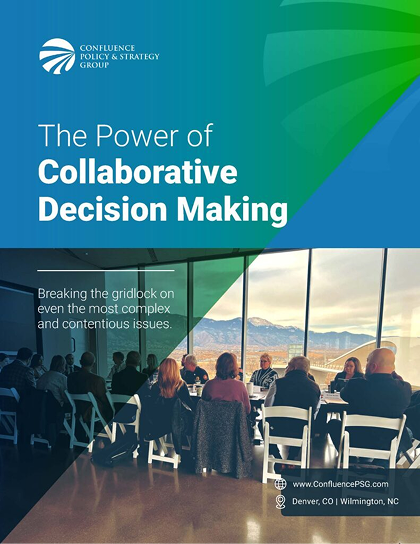
The whitepaper that launched Confluence PSG’s methodology into public practice. Written by Confluence founders Berrick Abramson and Carrie Steele, it makes the case that most high-stakes collaborative processes fail not because the people in them are unreasonable but because the processes themselves were designed wrong. It documents the CDMP framework in full, explains the reasoning behind each phase, and provides the evidence base for why the sequence produces outcomes that standard facilitation cannot.
The paper has been downloaded thousands of times. State agency leaders, legislative staff, foundation program officers, and county managers have used it to make the case internally for a process-first approach to their most difficult problems.
State agency leaders, Governor’s offices, county governments, and organizations navigating problems that have resisted every standard approach reach out directly. The engagement starts with a conversation.
CO · NC · FL · National