The Collaborative Decision Making Process

Why most high-stakes processes fail, and what to do instead.

The problem is almost never the people in the room. They are reasonable people with legitimate interests who have been put in the wrong sequence. The Collaborative Decision Making Process addresses that failure before the first session begins, and produces outcomes that standard facilitation cannot.

“I’ve done one to two task forces a year for the last 18 years. Hands down, this is the best run one. State agencies should just be required to hire you all.”

Working group member · Colorado state government

Unanimous support for an AI governance framework from parties who had been in direct opposition for two years.

Colorado AI Policy Working Group · SB26-189

An 11–2 vote on transit governance that had failed to reach a supermajority one week earlier.

RTD Accountability Committee · SB25-161

The diagnosis

Four reasons high-stakes processes fail before they begin.

Wrong sequence

Participants are asked to vote before they understand the problem, and to negotiate before they trust each other. The order determines the outcome.

Trust assumed, not built

Facilitators convene the group and assume participants are ready to engage openly. They are not. What they need before the first session is a private conversation.

Problem defined too late

Groups move to solutions before they have agreed on what problem they are solving. The result is proposals that talk past each other.

Positions, not language

Negotiations happen over abstract positions rather than actual text. Agreements that cannot be written down are not agreements.

34–1

Colorado AI Governance Framework · Senate vote · after three failed sessions

31

RTD governance recommendations codified in legislation after years of gridlock

58

Disability rights recommendations across four simultaneous subcommittees
 

50+

Work groups and task forces managed across nine issue areas

The framework

Five phases. Each one prerequisite to the next.

01

Trust and shared norms before substance

Before the first group session, Confluence conducts individual pre-session conversations with every participant. These are not briefings. They are the beginning of the process. Each conversation surfaces what the participant cares about, what they need to engage without reservation, and what would make the process feel legitimate to them. The group session that follows is built on what those conversations reveal.

Why this phase exists

People do not say in a group what they say in private. The facilitator who skips this step is designing a process around the public positions rather than the real interests. That process will produce theater, not agreement.

02

Align on the actual problem

Before any proposals are introduced, the group develops a shared definition of the problem they are trying to solve. This sounds obvious. It almost never happens in practice. Groups routinely spend months negotiating solutions to problems they have not agreed on, and wonder why the agreements do not hold. A shared problem definition is not consensus on the answer. It is the prerequisite for a productive conversation about answers.

Why this phase exists

Proposals introduced before the problem is defined are not solutions, they are opening positions. And opening positions produce defensive reactions, not deliberation.

03

Evidence before proposals

The group examines information and data before any party stakes a position. This includes bringing in external expertise, reviewing relevant research, and surfacing what is known and what is contested. A party that has staked a position before seeing the evidence will defend the position regardless of what the evidence shows. A party that examines the evidence first arrives at proposals that are grounded in something beyond their own starting point.

Why this phase exists

Evidence introduced after positions are staked becomes ammunition, not information. The sequence determines whether data is used to learn or to win.

04

Ideas before positions

The full range of options is explored before anyone commits to an outcome. This phase uses structured techniques to generate ideas without attribution, examine options without ownership, and identify what parties actually need rather than what they initially demanded. The difference between an interest and a position is often the difference between an impasse and an agreement.

Why this phase exists

Commitment to a position before exploring alternatives is not negotiation, it is an ultimatum dressed up as a process. Phase four creates the conditions for genuine deliberation.

05

Negotiate language, not ideology

The actual text of agreements is drafted together. This is the phase that produces the votes. A party that has negotiated the language of an agreement can defend it to its own constituency. A party that has been asked to vote on language drafted by someone else will vote against it even when they support the underlying idea. The difference between a unanimous vote and a failed vote is often nothing more than who wrote the words.

Why this phase exists

This is why gridlocked rooms reach unanimous conclusions. Not because the parties changed their minds. Because the sequence created conditions where agreement became possible.
It felt very safe, very easy to share opinions and life experiences. Being able to respect where everybody came from helped a lot in moving us forward.

Task force participant · civil rights engagement

The Whitepaper

The Power of Collaborative Decision Making: Breaking the Gridlock on Even the Most Complex and Contentious Issues

The whitepaper that launched Confluence PSG’s methodology into public practice. Written by Berrick Abramson, it makes the case that most high-stakes collaborative processes fail not because the people in them are unreasonable but because the processes themselves were designed wrong. It documents the CDMP framework in full, explains the reasoning behind each phase, and provides the evidence base for why the sequence produces outcomes that standard facilitation cannot.
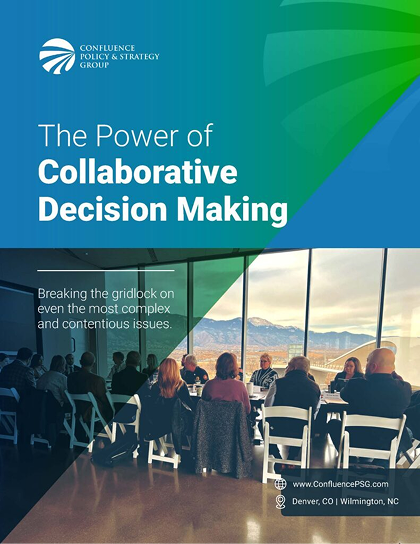
The paper has driven more than 1,300 website visits and a 45 percent email open rate. State agency leaders, legislative staff, foundation program officers, and county managers have used it to make the case internally for a process-first approach to their most difficult problems.
Confluence PSG · Berrick Abramson

The conversation starts
here.

State agency leaders, Governor’s offices, county governments, and organizations navigating problems that have resisted every standard approach reach out directly. The engagement starts with a conversation.

General Inquiries

inquiry@confluencepsg.com

Colorado

303.551.6989

North Carolina

910.239.8740

Geographic Reach

CO · NC · FL · National